

In 1961, when Warren Buffett was about our age, he bought shares in Sanborn Map. The business was elegant: fire insurers needed block-by-block data — proximity to fire stations, water mains, wooden construction — to price policies in every town in America, without putting boots on the ground. Sanborn’s surveyors fed updates to cartographers in New York, who produced thousands of detailed maps, printed them into 50-pound books, and sold them to underwriters.
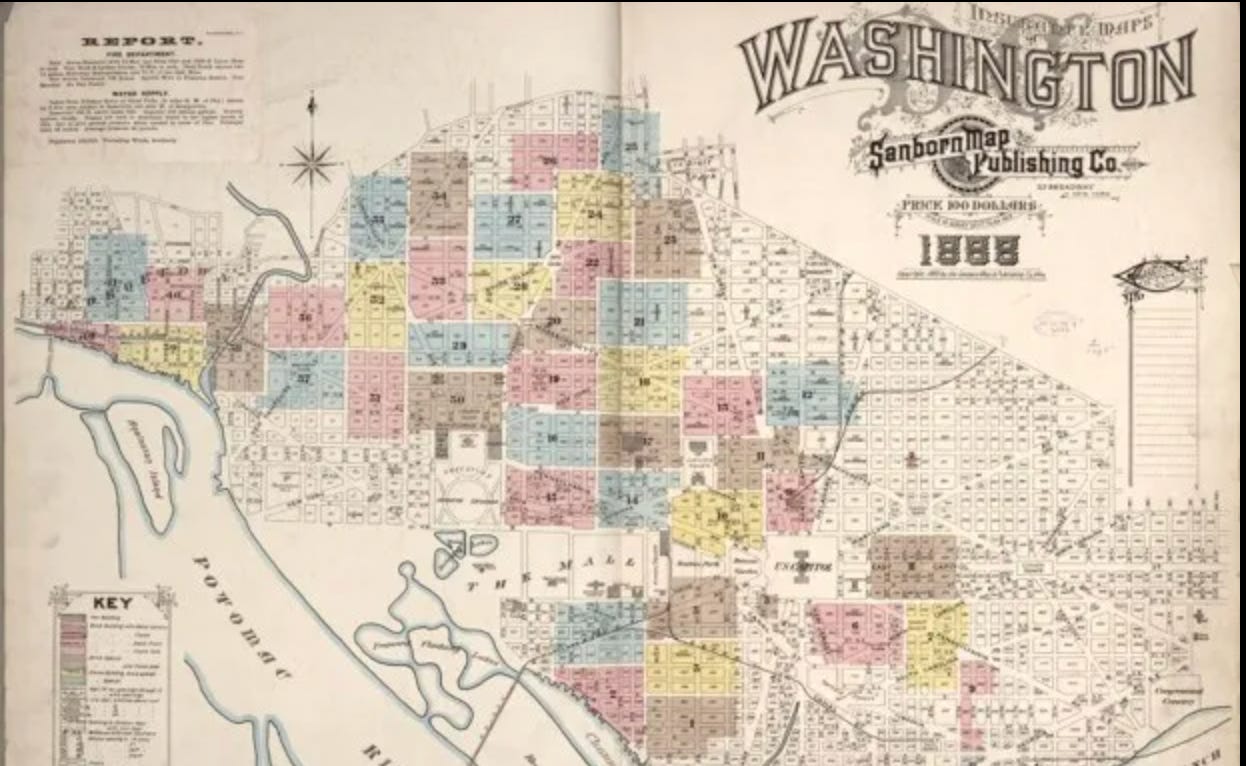
Producing and maintaining the map of a typical town cost Sanborn $175 a year. Each insurer paid $125 — and there were always at least two insurers per town. Sanborn ran 30% operating margins.
The first lesson is the oldest one in business: the best business models let you pay for something once and sell it many times. Sixty-five years later, a city map “weighs” 5 to 500 gigabytes instead of 50 pounds, refreshes in minutes instead of annually, and is assembled from cameras on drones, satellites, smartphones, and cars. But the economics haven’t budged: costs scale with coverage, revenues scale with demand, and the entire game is how many times you can resell the same map. Sanborn sold each map twice; today’s best mapmakers sell theirs five to ten times, to delivery oligopolists, telcos, airlines, and hedge funds — customers that didn’t exist in Sanborn’s day.
We believe the next customer will be the biggest of all: AI agents and robots, which will need constantly-refreshed maps of the physical world to do what users already expect of them. My glasses can’t tell me if there’s a line at the coffee shop; my car can’t tell if that noise was an accident on the next block. Closing that gap is a mapping problem.
But new demand stresses old models. Agents consume by the token, demanding ever-smaller, more granular maps — and selling many small maps makes it harder to resell the average one several times. Which brings us to the second lesson: match the granularity of your costs to the granularity of your demand. Bankers call the analogous sin a duration mismatch. Sanborn could hire a surveyor per metro area knowing two insurers would amortize the cost. Planet Labs prices its cheapest satellite API at one-hectare resolution because that’s where incremental cost meets incremental demand. Any business selling a fixed-cost asset in slices — software seats, ad inventory, GPU hours — faces the same test: can you control costs at the same unit size you sell at? Companies that granularity-match compound; those that don’t quietly subsidize every marginal sale.
This framework has led us to founders like Franck Marchis of Skymapper, who can expand his map of the night sky by mailing $350 routers to owners of telescopes he already sold them, and Niko Cunningham of Rumi, whose models run on users’ own phones — expanding coverage at near-zero marginal cost.
Those who know the Sanborn story should be skeptical, and so are we. In the 1920s, insurers discovered filing cabinets: one index card per policy, filed by neighborhood. Underwriters could count cards instead of consulting maps. By the time Buffett invested, Sanborn’s profits had fallen 80%, and he was blunt about it — he paid “70 cents on the dollar for Sanborn’s investment portfolio with the map business thrown in for nothing.” The third lesson: customers don’t buy your asset, they buy an outcome — and they’ll switch inputs the moment something cheaper delivers it. Proprietary data feels like a moat right up until it isn’t. The disruptors come from odd places, too: paper road atlases lost to a defense contractor (Garmin), which lost to a search engine (Google), which is now losing ground to a nonprofit-turned-AI-lab. If your moat is a dataset, your real risk isn’t a competitor with a better dataset; it’s a substitute that makes the dataset unnecessary.
So how do you make long-term bets in a category defined by disruption? The fourth lesson: anchor on the technology with the steepest, longest cost decline. For mapping, that’s the camera. The sun is the cheapest data source in the solar system; camera semiconductors are simple, commoditized, and manufactured by the billions. Everything cameras do today — driving cars, detecting anemia from a selfie, out-sniping snipers — was dismissed with the same argument (”cameras will never beat X at Y”) now aimed at their next act. As cameras get cheaper and sharper, the marginal cost of expanding a camera-based map falls every year, which makes granularity-matching easier over time, not harder. We’ve passed on mapmakers built on lasers and radar; we may be wrong, but we’d rather be wrong betting on a 50-year cost curve.
It’s a concentrated, non-consensus bet, and writing it down is partly how we hold ourselves accountable to it. If you’re an operator, investor, or founder thinking about maps — especially if you think we’re wrong — we’d love to compare notes. Read the original version of the post here.